Dutch road signs explained
Dutch road signs follow a strict visual grammar. The shape tells you the category, the colour tells you the type, and sub-signs modify the meaning. Learn the system once and every new sign becomes readable - even if you've never seen that specific sign before.
How to read any sign
Circles are commands
Every circular sign is either an order or a ban. If it's blue, it's telling you what you must do. If it has a red border on white, it's telling you what you must not do. Circular signs are never just information - they always carry a binding instruction.
Triangles are warnings
A triangular sign with the point facing up alerts you to something ahead - a junction, a hazard, a change in road conditions. Triangles don't give commands. They give you a heads-up so you can prepare. The inverted triangle (point down) is the yield sign specifically.
Rectangles are information
Rectangular and square signs provide information. They tell you what kind of road you're on, what's nearby, or give you directions. They don't instruct you to do anything - they're purely informational. The fietspad sign, fietsstraat sign, and direction signs are all rectangular.
The diamond is priority
The yellow diamond is a unique shape in Dutch signage - it means you're on a priority road. You have right of way over all crossing traffic at every junction along this road, until you see the end-of-priority sign.
Blue means mandatory
A solid blue circle with a white symbol means you must follow the instruction. The mandatory cycle path sign is the most common example - when you see a blue circle with a white bike, you're required to use that path. Other blue circles include the footpath sign and the shared path sign.
Red border means prohibition
A white circle with a red border prohibits whatever is shown inside. A bicycle inside means no cycling. A car means no motor vehicles. An empty white circle with just a red border means the road is closed in both directions to all traffic. The red is always the border, never the fill - that's what makes it a prohibition rather than a warning.
The red bar means no entry
A solid red circle with a white horizontal bar is the no-entry sign. This is the strongest prohibition - no vehicles may enter from this direction. You'll see it at the wrong end of one-way streets. It applies to cyclists unless there's an 'uitgezonderd fietsers' sub-sign below it.
Quick rule: shape tells you the category, colour tells you the type. A blue circle with a white bike = you must use that path. A white circle with a red border and a bike = you cannot cycle there.
Blue circles - mandatory
You must follow these instructions. A solid blue circle with a white symbol means you must follow the instruction - no exceptions unless a sub-sign says otherwise. The most important for cyclists is the mandatory cycle path (G11): when you see it, you must use that path. Riding on the adjacent road is a violation.
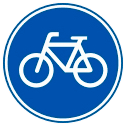
Mandatory cycle path
Verplicht fietspad
You must use this path. Cycling on the adjacent road is not permitted. Look for this round blue sign on paths running alongside main roads.
End-of variant: The same sign with a red diagonal sash means the mandatory path has ended. You may now choose to use the road.
Footpath
Voetpad
Pedestrians only. Cycling is not permitted on this path. If you see this sign, dismount and walk your bicycle or find an alternative route.
Cyclists and mopeds route
Fiets/bromfietspad
Mandatory path for both cyclists and mopeds. Be aware that mopeds may be moving faster than you on this path.
The end-of pattern
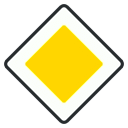
Priority road

End of priority road
Red diagonal sash means 'end of'
When a sign appears with a red diagonal line drawn through it, it means the rule that sign represents has ended. A mandatory cycle path sign with a red sash means 'end of mandatory cycle path' - from this point you may choose to ride on the road. A speed limit sign with a red sash means the speed limit zone has ended. The sash always means termination of the rule, not contradiction of it.
Grey diagonal lines mean 'end of zone'
Similar to the red sash, grey diagonal lines through a sign mark the end of a zone. The priority road sign with grey diagonals means 'end of priority road' - your automatic priority at junctions no longer applies from this point. Grey is used for zone endings rather than individual sign endings.
Red borders - prohibition
These actions are forbidden.A white circle with a red border prohibits whatever is shown inside. These always apply to you unless an ‘uitgezonderd fietsers’ sub-sign is present below.
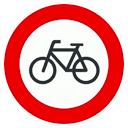
No cycling
Verboden fietsen
Cycling is not permitted on this road or path. You may generally still walk your bicycle through, though always check for additional restrictions.
No cycling or mopeds
Gesloten voor fietsen en bromfietsen
Neither cycling nor moped riding is permitted. This is a broader restriction than the no-cycling sign alone.
No entry
Verboden in te rijden
No vehicles may enter from this direction. You'll see this at the wrong end of one-way streets. Applies to cyclists unless an 'uitgezonderd fietsers' sub-sign is present.
Road closed in both directions
Gesloten voor alle verkeer
The road is closed to all traffic in both directions. No entry from either end.
No pedestrians
Verboden voor voetgangers
Pedestrians are not permitted. This path or road is exclusively for vehicles and/or cyclists.
Sub-signs
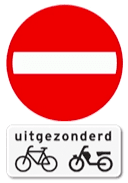
Small rectangular signs mounted below a main sign change its meaning. The most important for cyclists is 'uitgezonderd' (except/exempt) - a no-entry sign with 'uitgezonderd fietsers' means cyclists may enter even though other traffic cannot. Another common one is 'bestemmingsverkeer' (destination traffic) - meaning the restriction doesn't apply to residents and deliveries. Always read the sub-sign together with the main sign above it.
Priority signs & markings
These determine who goes first at junctions. The priority road diamond and shark teeth markings override the right-before-left default at every junction where they appear.
Priority road
Voorrangsweg
You are on a priority road. All crossing traffic must yield to you at every junction along this road. Does not grant priority over pedestrians at zebra crossings.
End-of variant: The same diamond with grey diagonal lines means end of priority road. Your automatic priority at junctions no longer applies.
Shark teeth (road marking)
Haaientanden
White triangles painted on the road surface. Pointing toward you means you must yield. Overrides right-before-left. The most important marking to recognise as a cyclist in the Netherlands.
Your traffic light
Lights that control your movement at junctions. The cyclist traffic light is positioned at handlebar height, not at car height. It is legally independent from the car signal - your red is your red, regardless of what the large light shows.
Cyclist traffic light
Verkeerslicht voor fietsers
A small traffic light with a bicycle symbol on the lens, positioned at handlebar height. This is your light - not the large car light next to it. When your cyclist light is red, you stop, even if the car light is green. Legally binding and independent from the car signal.
Information signs
These tell you facts about the road. No command, just information. These rectangular signs tell you facts about the road - they carry no command.
Optional cycle path
Onverplicht fietspad
A cycle path you may use but are not required to. You can choose to ride on the road instead. Recognisable by the rectangular white sign with blue border - distinct from the round mandatory sign.
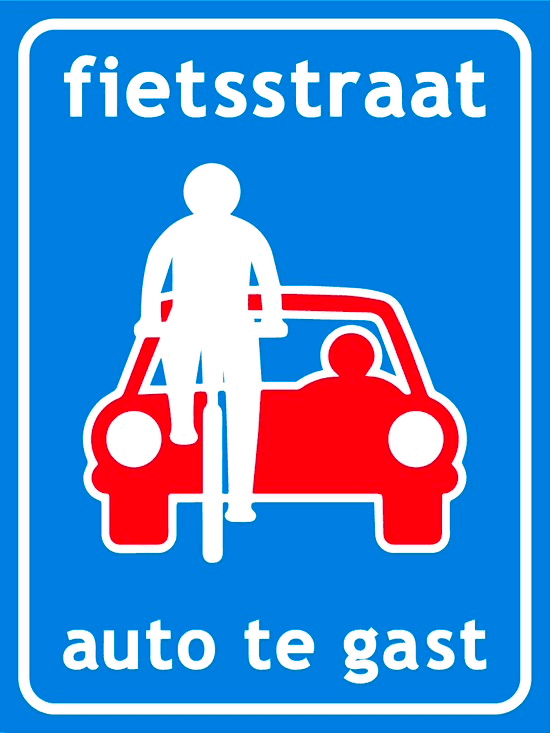
Bicycle street
Fietsstraat
Cyclists are the primary road users. Cars are guests (auto te gast) and may not overtake cyclists. Hold your position - the car behind you must wait.
End-of variant: A similar sign with grey diagonal lines means end of fietsstraat - normal traffic rules resume.
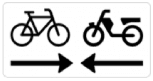
Cyclists in both directions
Fietsers in twee richtingen
Alerts road users (usually car drivers) that cyclists travel in both directions on this road or path, even if the road is one-way for cars.
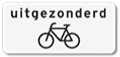
Except cyclists (sub-sign)
Uitgezonderd fietsers
A sub-sign mounted below a prohibition sign. Means cyclists are exempt from the restriction above. Most commonly seen below no-entry signs on one-way streets, allowing cyclists to travel in both directions.
Mandatory vs optional - the key distinction
G11
Round blue sign
Must use
G13
White rectangle
Your choice